Causal artificial intelligence (AI) · Model guide
Switching linear dynamical systems
Switching linear dynamical system (SLDS)
Track a continuous system without assuming it stays in one operating regime.
Combine a finite switching regime with linear Gaussian state and observation dynamics.
Also known as: SLDS, Switching LDS.
The model in pictures
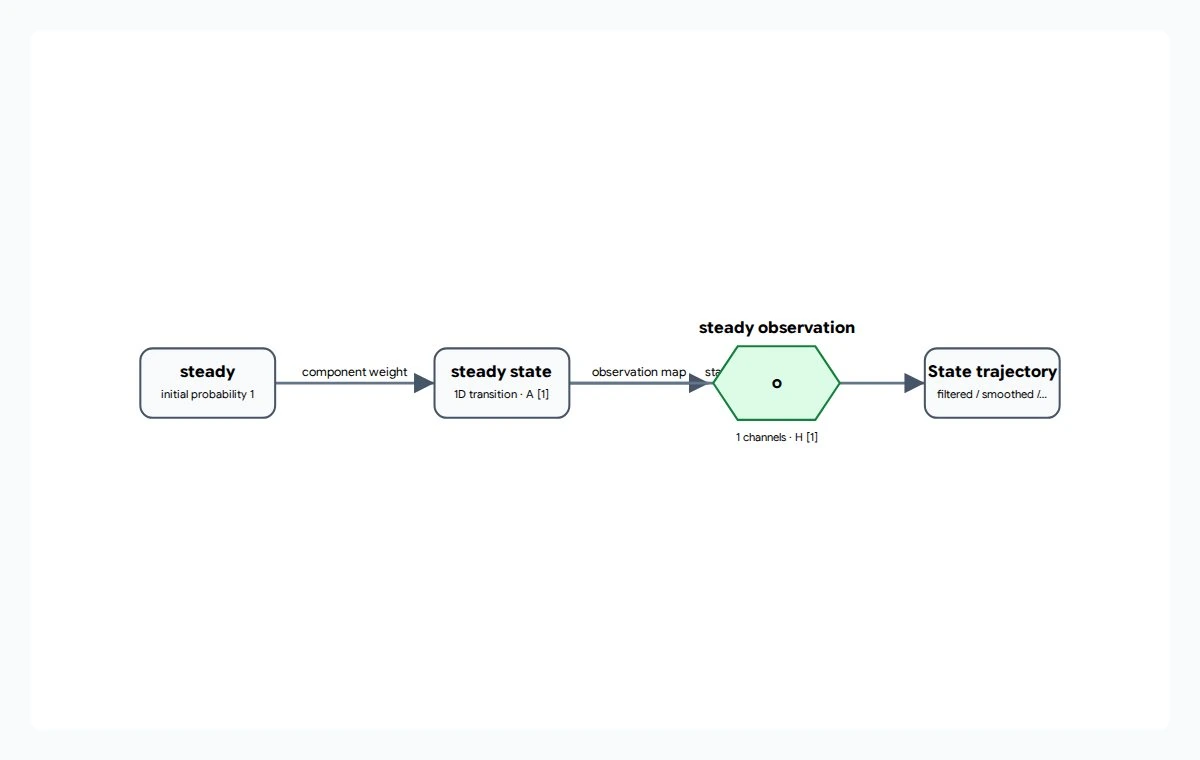
Switching linear dynamical system (SLDS)
A time-based numeric model that can switch between distinct linear motion or behavior regimes. Within each regime, it tracks hidden state and noisy observations.
How can a hidden state trajectory be estimated from a sequence of noisy measurements?
The diagram connects a regime, its state dynamics, its measurement model and the trajectory output. This starter has only the steady regime, so it does not demonstrate an actual regime switch or a computed trajectory.
Synthetic example, not real patient, customer or operational data.
Variables and symbols
- steady
- The single regime in this fixture, with initial probability 1.
- steady state
- One hidden numeric state; 1D means one-dimensional. A is its linear transition coefficient.
- steady observation
- One noisy measurement channel. H maps hidden state to a predicted measurement; O means observation.
- State trajectory
- The series of state estimates over time, produced by an analysis rather than displayed here.
When to use it
Track a moving system as it switches between motion regimes.
Applications
- Motion tracking: estimate a path across steady, turning, and accelerating regimes.
- Equipment monitoring: infer operating modes and continuous condition from noisy telemetry.
Why it matters
Filtered state and regime probabilities can trigger review or planning, but the family does not expose a causal answer about the effect of that action.
Questions you can ask
- What is the filtered state distribution after new observations?
Causal boundary
This family does not expose causal intervention or counterfactual queries. Dependencies, rules, dynamics, and decision actions alone do not establish those semantics.
Profile and resource limits
Exact regime-path mixtures are bounded and can grow exponentially; particle approximations must be requested explicitly and report their quality.
Online uses protected execution with plan and request limits. Check the returned method, exactness, and resource diagnostics for each query.
Existing workspace example
Switching Linear Dynamical System
Finite regime switching with Gaussian state transitions, observations, exact mixtures, and bounded particle fallback. Explore its visual structure, edit the model through the workspace controls, and run the available analysis.
After signing in, open the workspace example gallery and choose this example. Workspace access and actions follow your plan.
Sign in to explore examplesUse it in your application
Released through the native engine and host software development kits (SDKs). Online and SDK resource profiles differ; check the documentation bundled with your exact SDK version.
Read SDK guidance and examples