Causal artificial intelligence (AI) · Model guide
Relational Bayesian models
Probabilistic relational model (PRM) / object-oriented Bayesian network (OOBN)
Define a repeated probabilistic pattern once, then query individual objects in a finite connected system.
Describe repeated classes, attributes, references, and finite object systems with reusable probabilistic structure.
Also known as: PRM, OOBN.
The model in pictures
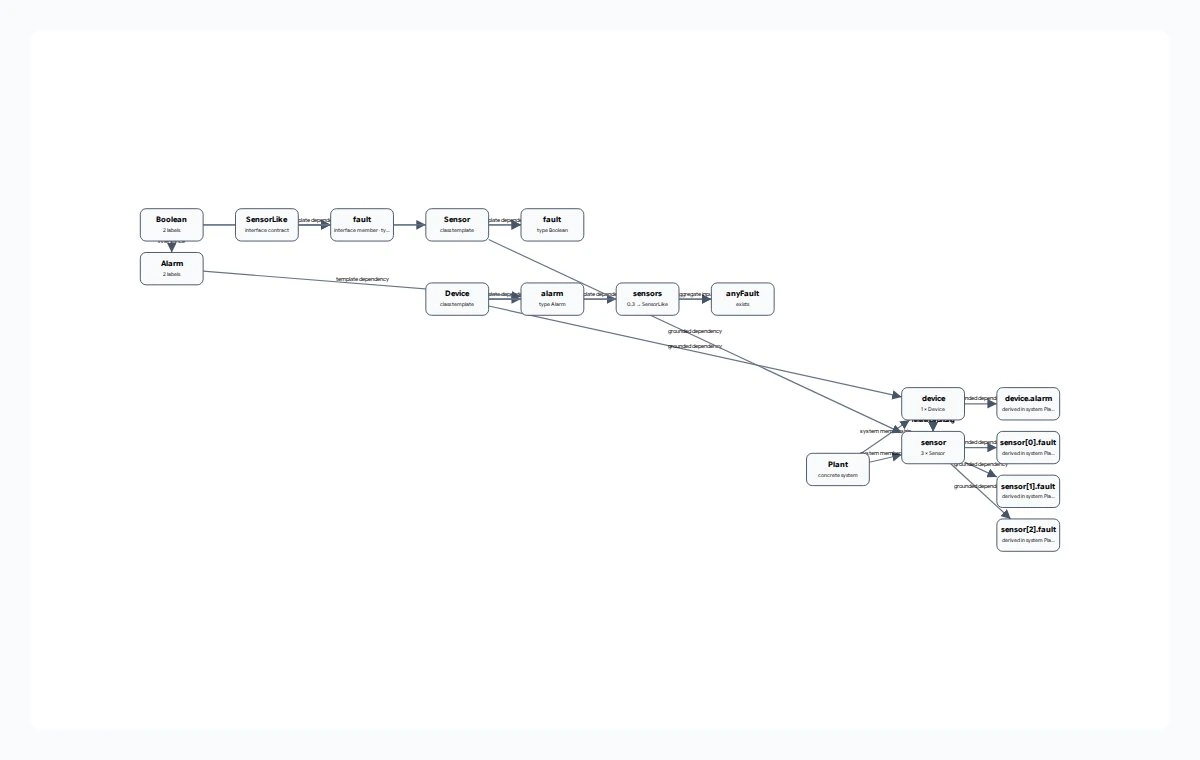
Probabilistic relational model (PRM) / object-oriented Bayesian network (OOBN)
A probability model assembled from reusable object templates and their relationships. The same sensor template can describe several sensors without writing a separate model for each one.
How likely is a device alarm when any of its connected sensors may be faulty?
The upper boxes are types, interfaces and templates; the lower boxes are the concrete Plant, device and three sensor instances. Arrows include template and object dependencies, so not every box is a measured variable.
Synthetic example, not real patient, customer or operational data.
Variables and symbols
- sensor[0].fault, sensor[1].fault, sensor[2].fault
- Whether each of the three sensors is faulty: false or true.
- device.alarm
- Whether the device alarm is false or true.
- anyFault and sensors
- anyFault asks whether at least one connected sensor is faulty; sensors is the device's reference to those objects.
- Boolean, Alarm, SensorLike, Sensor, Device, Plant
- Boolean and Alarm define value types; SensorLike defines a shared interface; Sensor and Device are reusable templates; Plant is the concrete collection of instances.
When to use it
Use a device template across a plant and query an individual alarm.
Applications
- Plant operations: reuse one device template across a finite equipment inventory.
- Supply networks: reason about repeated suppliers, parts, and dependency references.
Why it matters
Object-level marginals identify where evidence changes risk in a repeated system; they do not estimate the effect of intervening on an attribute.
Questions you can ask
- What is the marginal probability of an object attribute?
Causal boundary
This family does not expose causal intervention or counterfactual queries. Dependencies, rules, dynamics, and decision actions alone do not establish those semantics.
Profile and resource limits
Closed-world finite systems with bounded references, grounding, and exact factor work. Structured inference is explicit and may refuse an ineligible request.
Online uses protected execution with plan and request limits. Check the returned method, exactness, and resource diagnostics for each query.
Existing workspace example
Finite Discrete PRM / OOBN
Finite relational class templates, reference slots, object instances, and grounded discrete inference. Explore its visual structure, edit the model through the workspace controls, and run the available analysis.
After signing in, open the workspace example gallery and choose this example. Workspace access and actions follow your plan.
Sign in to explore examplesUse it in your application
Released through the native engine and host software development kits (SDKs). Online and SDK resource profiles differ; check the documentation bundled with your exact SDK version.
Read SDK guidance and examples