Causal artificial intelligence (AI) · Model guide
Probabilistic soft logic
Probabilistic soft logic (PSL) / hinge-loss Markov random field (HL-MRF)
Turn conflicting weighted rules into one inspectable soft assignment instead of hiding disagreement behind a binary label.
Find soft truth values that best satisfy weighted hinge-loss rules and hard constraints.
Also known as: PSL, HL-MRF.
The model in pictures
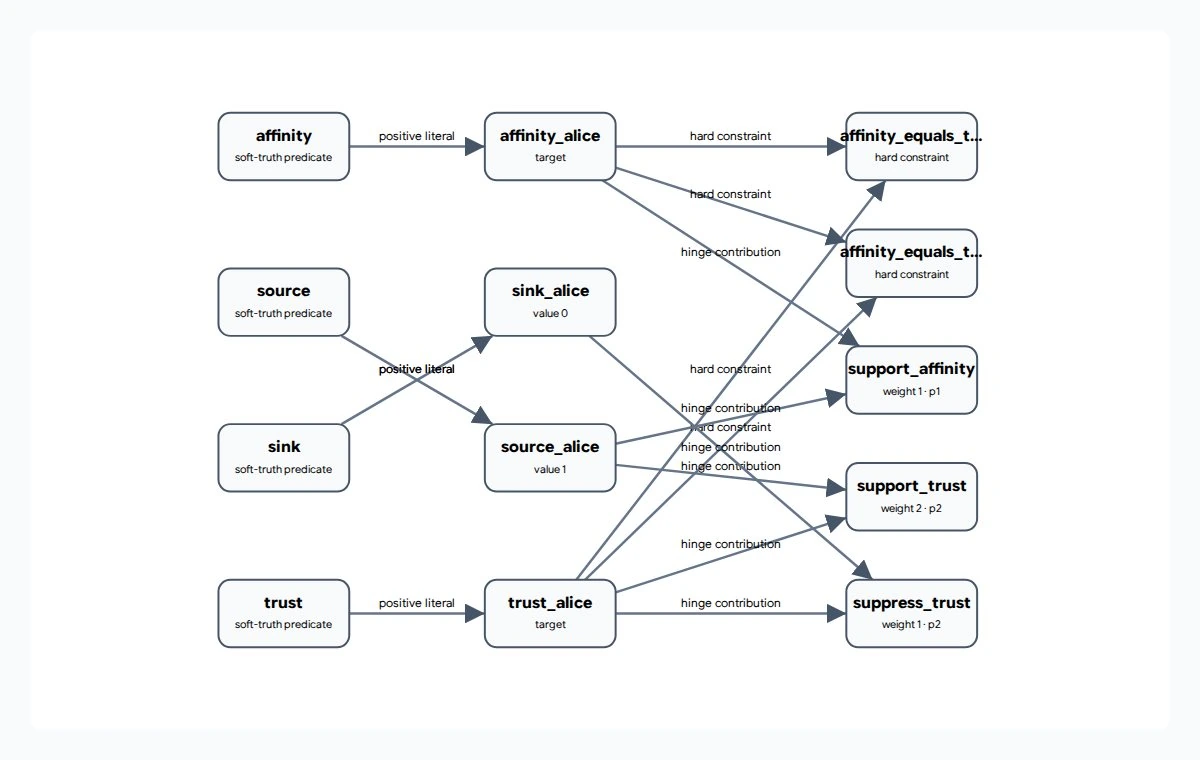
Probabilistic soft logic (PSL) / hinge-loss Markov random field (HL-MRF)
A model of graded truth values between 0 and 1, constrained by rules. Hard rules must hold; weighted soft rules may be violated at a cost, which the model minimizes.
Which affinity and trust scores best satisfy the supplied rules together?
The diagram connects abstract predicates, their values for alice, and hard or weighted rules. These are soft-truth scores, not calibrated probabilities. Hinge contributions measure rule violations that add to the objective.
Synthetic example, not real patient, customer or operational data.
Variables and symbols
- affinity_alice and trust_alice
- Two unknown scores from 0 to 1; these are abstract fixture names, not measured attributes of a real person.
- source_alice and sink_alice
- Fixed reference scores of 1 and 0 that supply supporting and opposing constraints.
- affinity_equals_trust
- Two hard rules require the affinity and trust scores to match.
- support_affinity, support_trust, suppress_trust
- Weighted rules that favor or oppose scores. Weight sets the cost strength; p1 and p2 denote linear and squared violation penalties.
When to use it
Balance conflicting relational signals when scoring how strongly entities match.
Applications
- Entity resolution: balance similarities and relational constraints when scoring possible matches.
- Content ranking: reconcile weighted preferences and hard eligibility rules.
Why it matters
The optimum identifies the assignment that best fits the declared rule objective; it is neither a calibrated probability nor a causal effect.
Questions you can ask
- Which soft truth assignment minimizes the rule objective?
Causal boundary
This family does not expose causal intervention or counterfactual queries. Dependencies, rules, dynamics, and decision actions alone do not establish those semantics.
Profile and resource limits
MAP soft truth is an optimization result, not a normalized probability marginal or classical MLN answer. Grounding and convergence limits apply.
Online uses protected execution with plan and request limits. Check the returned method, exactness, and resource diagnostics for each query.
Existing workspace example
PSL HL-MRF
Probabilistic soft logic over bounded truth values with weighted hinge-loss rules and hard constraints. Explore its visual structure, edit the model through the workspace controls, and run the available analysis.
After signing in, open the workspace example gallery and choose this example. Workspace access and actions follow your plan.
Sign in to explore examplesUse it in your application
Released through the native engine and host software development kits (SDKs). Online and SDK resource profiles differ; check the documentation bundled with your exact SDK version.
Read SDK guidance and examples