Causal artificial intelligence (AI) · Model guide
Probabilistic logic programs
Probabilistic logic program (PLP)
Trace a probability through explicit rules so the route from uncertain facts to a conclusion remains inspectable.
Combine independent probabilistic facts with deterministic rules over a finite declared universe.
Also known as: ProbLog subset, Finite PLP.
The model in pictures
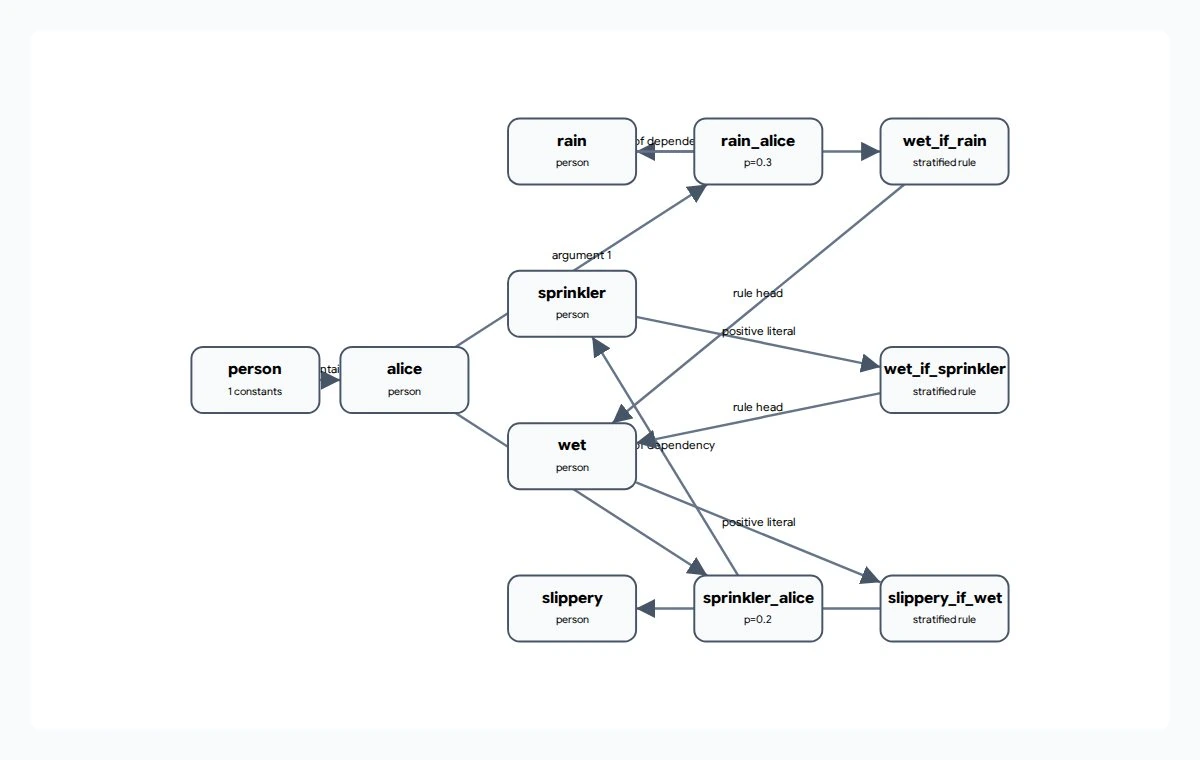
Probabilistic logic program (PLP)
A model combining uncertain facts with logical rules. It calculates how uncertainty in the facts affects conclusions obtained by following those rules.
How likely is a slippery condition if either rain or a sprinkler can make things wet?
Boxes show the named entity, fact types, uncertain facts and rules. Rain and sprinkler facts can each imply wet, and wet implies slippery. Rule links express logical dependencies, not an estimated causal effect.
Synthetic example, not real patient, customer or operational data.
Variables and symbols
- person and alice
- person is the entity type; alice is the single named example entity, not real personal data.
- rain_alice and sprinkler_alice
- True/false uncertain facts for that entity, with probabilities p = 0.3 and p = 0.2.
- wet and slippery
- True/false conclusions derived by the rules.
- wet_if_rain, wet_if_sprinkler, slippery_if_wet
- The three implication rules. A rule head is its conclusion; a positive literal is an unnegated fact used by a rule.
When to use it
Ask whether a wet surface follows from uncertain rain and sprinkler facts.
Applications
- Fault analysis: combine uncertain component facts with finite diagnostic rules.
- Compliance review: calculate whether a declared condition follows from uncertain records and deterministic policy rules.
Why it matters
The result shows which conclusions deserve review and which facts support them; changing a fact is scenario analysis, not an identified causal effect.
Questions you can ask
- What is the probability that a ground fact follows from the rules?
Causal boundary
This family does not expose causal intervention or counterfactual queries. Dependencies, rules, dynamics, and decision actions alone do not establish those semantics.
Profile and resource limits
Finite stratified rules and bounded grounding/proof compilation; overlapping proofs must not double-count probability. Arbitrary code and open-ended recursion are outside the profile.
Online uses protected execution with plan and request limits. Check the returned method, exactness, and resource diagnostics for each query.
Existing workspace example
Finite Probabilistic Logic Program
Finite stratified probabilistic facts and deterministic rules with weighted Boolean compilation. Explore its visual structure, edit the model through the workspace controls, and run the available analysis.
After signing in, open the workspace example gallery and choose this example. Workspace access and actions follow your plan.
Sign in to explore examplesUse it in your application
Released through the native engine and host software development kits (SDKs). Online and SDK resource profiles differ; check the documentation bundled with your exact SDK version.
Read SDK guidance and examples