Causal artificial intelligence (AI) · Model guide
Probabilistic circuits
Probabilistic circuit (PC)
Reuse a structured probability calculation for repeated scoring and marginal queries.
Organize a distribution as a circuit of weighted sums and products.
Also known as: SPN.
The model in pictures
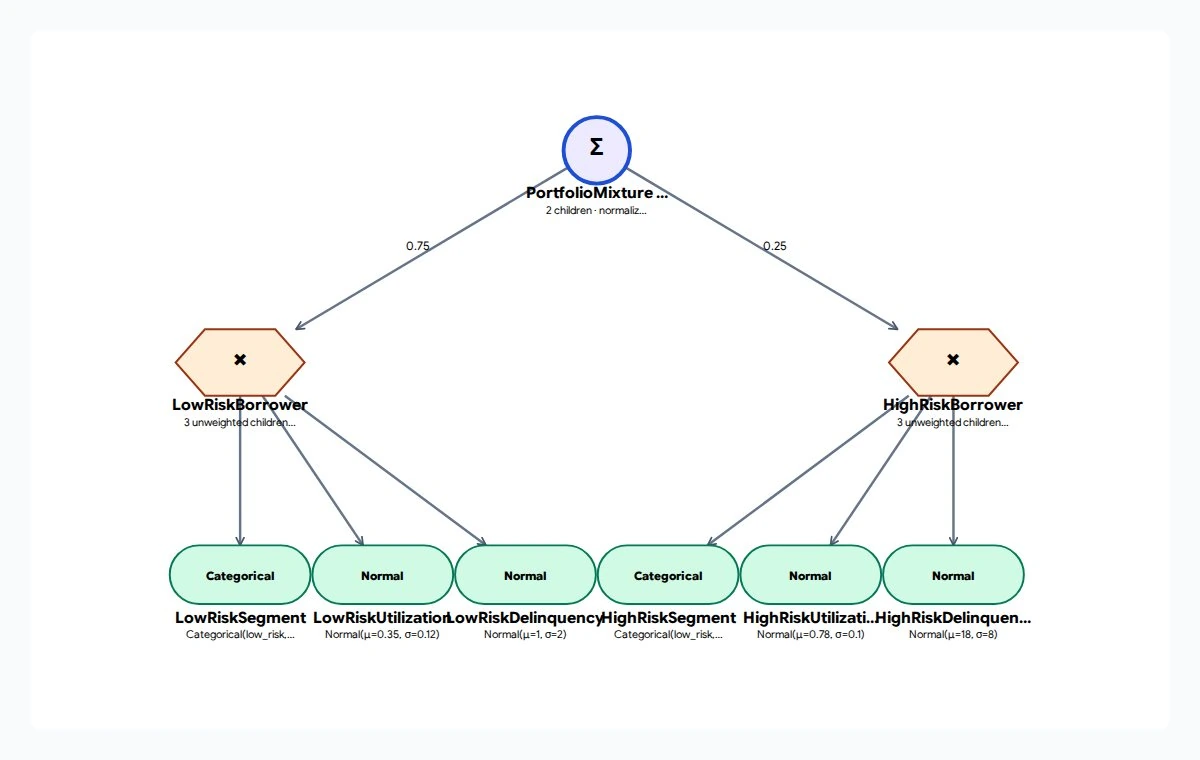
Probabilistic circuit (PC)
A probability model built from small distributions combined by sums and products. This example mixes two borrower groups with different credit-use and late-payment patterns.
How well does a borrower's credit use and payment history fit the modeled portfolio?
The top sum blends low-risk and high-risk branches with weights 0.75 and 0.25. Product nodes combine the three characteristics within each branch. The leaves describe distributions; these connections are calculation steps, not causal arrows.
Synthetic example, not real patient, customer or operational data.
Variables and symbols
- BorrowerSegment
- The modeled group: low_risk or high_risk, represented by the Segment leaves.
- CreditUtilization
- The fraction of available credit used, represented by the Utilization leaves.
- DelinquencyDays
- Days late on payment, approximated by the Delinquency leaves' normal distributions.
- Sum, product, mu, sigma
- Sum mixes branches; product combines their inputs. Mu is a normal distribution's mean; sigma is its standard deviation, a measure of spread.
When to use it
Represent borrower segments through a reusable hierarchy of probability components.
Applications
- Risk segmentation: score profiles against a declared hierarchy of probability components.
- Anomaly review: compare how well incoming records fit a tractable distribution.
Why it matters
Use likelihood and marginal results to route review or compare records, but do not read circuit structure as evidence that an action causes an outcome.
Questions you can ask
- How likely is an observed borrower profile?
Causal boundary
This family does not expose causal intervention or counterfactual queries. Dependencies, rules, dynamics, and decision actions alone do not establish those semantics.
Profile and resource limits
Only the declared circuit validity and tractability profile is supported; circuit structure does not itself establish causality.
Online uses protected execution with plan and request limits. Check the returned method, exactness, and resource diagnostics for each query.
Existing workspace example
Borrower Segment Circuit
Represent low- and high-risk borrower segments with different utilization and delinquency distributions. Follow evidence through categorical leaves, Gaussian leaves, products, and the portfolio mixture.
After signing in, open the workspace example gallery and choose this example. Workspace access and actions follow your plan.
Sign in to explore examplesUse it in your application
Released through the native engine and host software development kits (SDKs). Online and SDK resource profiles differ; check the documentation bundled with your exact SDK version.
Read SDK guidance and examples