Causal artificial intelligence (AI) · Model guide
Nonlinear state-space models
Estimate hidden state when straight-line dynamics and Gaussian noise are not credible assumptions.
Describe nonlinear stochastic dynamics with a closed, serializable mechanism vocabulary.
Also known as: NNGSSM, Particle State-Space.
The model in pictures
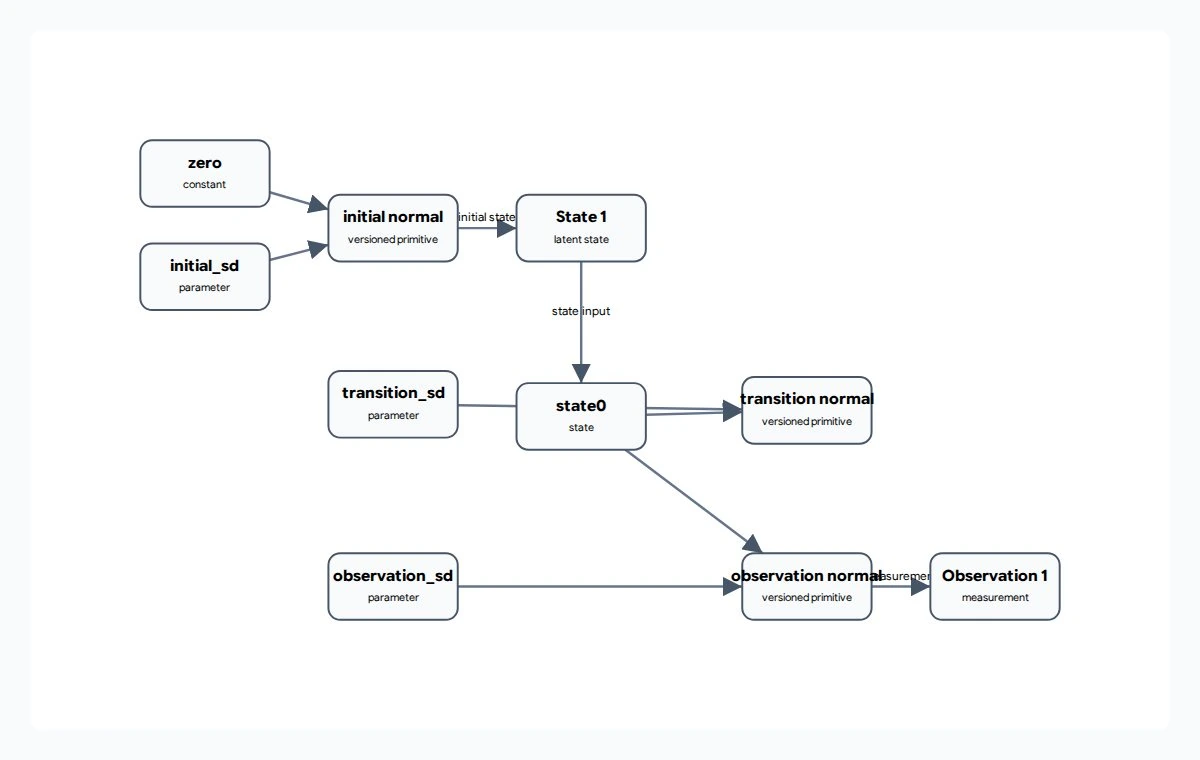
Nonlinear, non-Gaussian state-space model
A model separating hidden state evolution from observations, with flexible equations and probability distributions. It is not restricted to linear relationships or bell-shaped uncertainty.
How can observations update a hidden state when more flexible dynamics are needed?
The boxes expose the expressions and distributions used for initial state, state transitions and measurements. This particular starter uses normal distributions and simple dynamics; it does not itself demonstrate non-Gaussian behavior.
Synthetic example, not real patient, customer or operational data.
Variables and symbols
- State 1 and state0
- The single hidden state and its expression reference; state0 uses zero-based indexing, not a second physical variable.
- Observation 1
- The single measurement channel for that state.
- initial_sd, transition_sd, observation_sd
- sd means standard deviation: the spread of initial uncertainty, state-change noise and measurement noise.
- zero and normal
- zero is the constant 0. Normal means a Gaussian, or bell-shaped, distribution in each of the three depicted mechanisms.
When to use it
Estimate hidden state when observations and transitions do not fit a linear Gaussian model.
Applications
- Robotics: track a nonlinear motion state from noisy observations.
- Energy operations: estimate a changing system whose transition or measurement response is nonlinear.
Why it matters
Particle estimates show the range of plausible hidden states for monitoring or planning; they do not identify the effect of an intervention.
Questions you can ask
- What does particle filtering infer about the hidden state?
Causal boundary
This family does not expose causal intervention or counterfactual queries. Dependencies, rules, dynamics, and decision actions alone do not establish those semantics.
Profile and resource limits
Seeded particle inference is approximate only. Particle count, horizon, expressions, and ancestry are bounded; arbitrary host-language callbacks are unsupported.
Online uses protected execution with plan and request limits. Check the returned method, exactness, and resource diagnostics for each query.
Existing workspace example
Nonlinear Non-Gaussian State-Space Model
Versioned expression graphs and distribution bindings evaluated by bounded particle inference. Explore its visual structure, edit the model through the workspace controls, and run the available analysis.
After signing in, open the workspace example gallery and choose this example. Workspace access and actions follow your plan.
Sign in to explore examplesUse it in your application
Released through the native engine and host software development kits (SDKs). Online and SDK resource profiles differ; check the documentation bundled with your exact SDK version.
Read SDK guidance and examples