Causal artificial intelligence (AI) · Model guide
Latent causal models
Test a decision without silently treating hidden shared causes as if they were measured evidence.
Use explicit correlated disturbances to represent shared causes that are not directly observed.
Also known as: LatentSEM.
The model in pictures
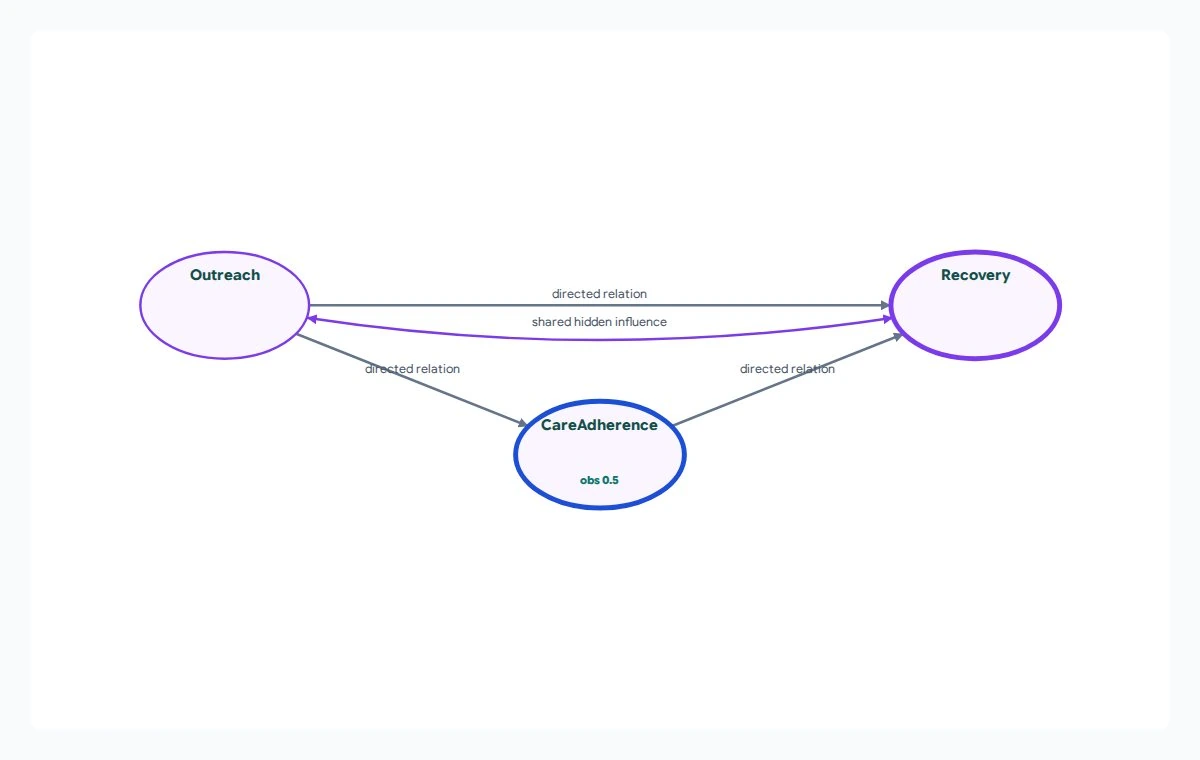
Latent causal model
A causal model that allows unmeasured influences to affect more than one observed variable. Latent means hidden; confounding means a shared influence can complicate an apparent cause-and-effect relationship.
How might outreach affect recovery when unmeasured need also influences both?
Directed connections express the example's assumed pathways through outreach and care adherence. The additional curved connection represents shared hidden influence between outreach and recovery. Those assumptions must be justified separately from the picture.
Synthetic example, not real patient, customer or operational data.
Variables and symbols
- Outreach
- The numeric level of outreach in the model.
- CareAdherence
- The numeric degree of following the care plan; obs 0.5 is entered evidence.
- Recovery
- The modeled numeric recovery outcome.
- Hidden influence
- Unmeasured shared variation, illustrated by community need; it is not an extra measured node in this screenshot.
When to use it
Compare community outreach scenarios when hidden factors affect participation and outcomes.
Applications
- Public-program modeling: compare outreach scenarios while declaring hidden participation factors.
- Operations research: test a policy under explicit assumptions about unmeasured shared drivers.
Why it matters
The answer makes hidden-confounding assumptions part of the decision record instead of burying them in an observed association.
Questions you can ask
- What outcome does the model predict from the observed evidence?
- How does the modeled outcome change under an intervention?
- For a factual case, what outcome would the model predict under a different action?
Causal boundary
Supports interventions under the model’s declared structural assumptions.
Counterfactual queries additionally rely on the declared shared-noise model. These answers do not establish that the supplied causal assumptions hold in the real world.
Profile and resource limits
Causal answers depend on the supplied structural model and confounding assumptions; observational data alone does not establish them.
Online uses protected execution with plan and request limits. Check the returned method, exactness, and resource diagnostics for each query.
Existing workspace example
Community Outreach with Hidden Confounding
Study how outreach may improve adherence and recovery while unmeasured community need affects both outreach and outcomes. Contrast conditioning, intervention, and counterfactual questions.
After signing in, open the workspace example gallery and choose this example. Workspace access and actions follow your plan.
Sign in to explore examplesUse it in your application
Released through the native engine and host software development kits (SDKs). Online and SDK resource profiles differ; check the documentation bundled with your exact SDK version.
Read SDK guidance and examples