Causal artificial intelligence (AI) · Model guide
Hybrid dynamic models
Conditional linear Gaussian dynamic Bayesian network (CLG DBN)
Track a changing numerical system even when its behavior switches between distinct operating modes.
Extend conditional linear Gaussian relationships across time while retaining categorical regimes.
Also known as: CLGDBN.
The model in pictures
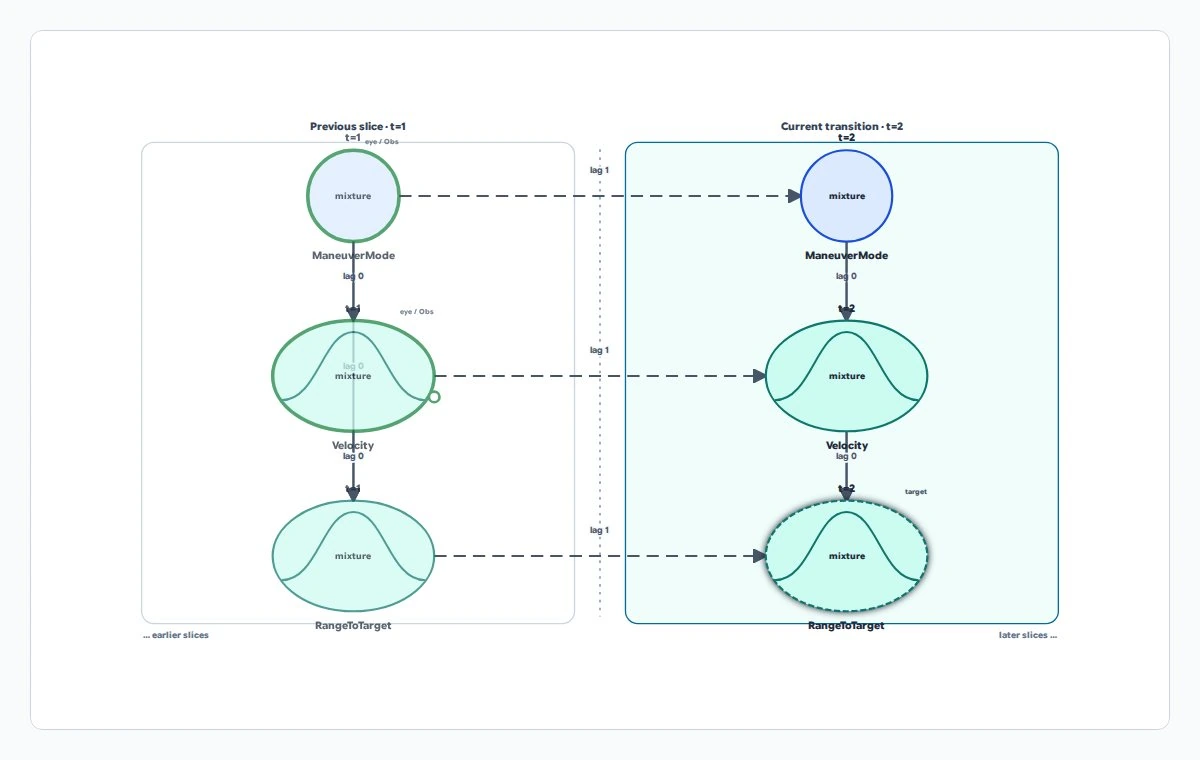
Conditional linear Gaussian dynamic Bayesian network (CLG DBN)
A time-based model combining discrete modes with numeric measurements. The mode selects a linear, Gaussian motion pattern as the system evolves.
How does an evasive maneuver change the expected range to the tracked aircraft?
Two time panels repeat the maneuver category, velocity and range. Dashed arrows carry state forward; numeric curves summarize uncertainty within the mode mixture. The highlighted nodes mark entered evidence and a query target.
Synthetic example, not real patient, customer or operational data.
Variables and symbols
- ManeuverMode
- The flight category: steady or evasive.
- Velocity
- The modeled numeric velocity.
- RangeToTarget
- The modeled distance to the tracked target; the fixture does not declare a physical unit.
- t, lag, Obs
- t is the time-step index; lag 0 is within a step and lag 1 is between steps. Obs means observation.
When to use it
Follow a maneuvering aircraft whose motion changes with its flight regime.
Applications
- Fleet monitoring: follow vehicle motion as maneuver regimes change.
- Industrial operations: estimate process state across startup, steady, and fault regimes.
Why it matters
The forecast identifies both a likely regime and trajectory; causal modes compare how a declared input would redirect that modeled path.
Questions you can ask
- What trajectory distribution follows the latest measurement?
- How does the trajectory change when a control input or regime is set?
- Given the observed path, what would the model predict under a different control input?
Causal boundary
Supports interventions under the model’s declared structural assumptions.
Counterfactual queries additionally rely on the declared shared-noise model. These answers do not establish that the supplied causal assumptions hold in the real world.
Profile and resource limits
Regime paths and Gaussian mixtures grow with horizon; exact requests refuse excess work rather than silently approximate.
Online uses protected execution with plan and request limits. Check the returned method, exactness, and resource diagnostics for each query.
Existing workspace example
Maneuvering Aircraft Tracker
Track a categorical maneuver mode alongside continuous velocity and range-to-target. Add a sensor reading, then compare exact switching-state inference with Rao-Blackwellized particles.
After signing in, open the workspace example gallery and choose this example. Workspace access and actions follow your plan.
Sign in to explore examplesUse it in your application
Released through the native engine and host software development kits (SDKs). Online and SDK resource profiles differ; check the documentation bundled with your exact SDK version.
Read SDK guidance and examples