Causal artificial intelligence (AI) · Model guide
Gaussian processes
Gaussian process (GP)
Estimate an unmeasured point and see how uncertainty grows away from observed data.
Use a covariance kernel to describe uncertainty about a continuous function.
Also known as: GPR.
The model in pictures
Gaussian process (GP)
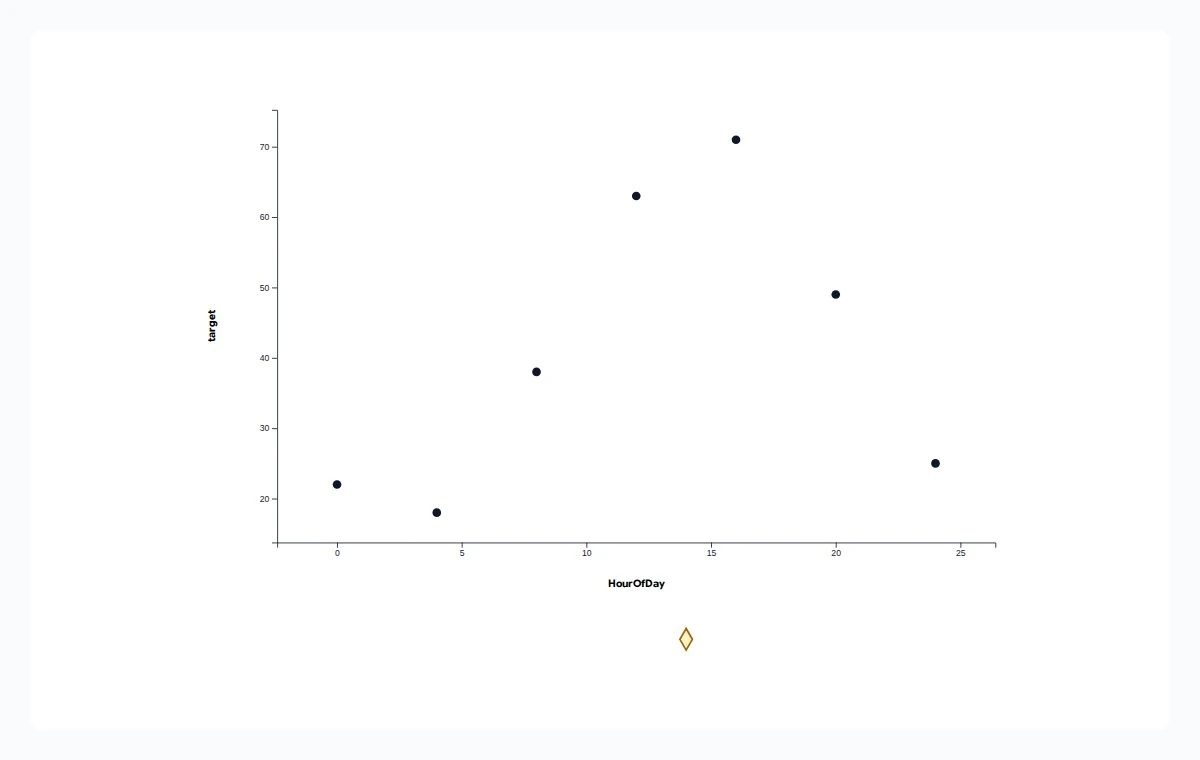
A model that learns how a numeric quantity varies with its inputs while keeping track of uncertainty. Here the input is time of day and the quantity is emergency arrivals.
How many arrivals might the hospital expect at a time between its observations?
This is a data chart, not a node-and-arrow network: each dot pairs an hour with an observed arrival count. It shows the seven training observations, not a computed forecast curve or uncertainty interval. The outlined diamond marks the prediction input, not an arrival count.
Synthetic example, not real patient, customer or operational data.
Variables and symbols
- HourOfDay
- The horizontal input: hours from 0 to 24 in this synthetic daily example.
- target
- The vertical quantity to predict: the example's emergency-arrival count at each observation time.
- Prediction input
- The requested time is hour 14. A prediction query returns an estimated value and its uncertainty separately.
When to use it
Estimate hospital demand between observed input points with uncertainty intervals.
Applications
- Demand planning: interpolate expected demand between measured operating conditions.
- Process monitoring: estimate a response surface and identify regions with little supporting data.
Why it matters
The mean and variance help choose where to measure or review next, but changing an input is a predictive comparison rather than a causal intervention.
Questions you can ask
- What mean and variance does the model predict at a new input?
Causal boundary
This family does not expose causal intervention or counterfactual queries. Dependencies, rules, dynamics, and decision actions alone do not establish those semantics.
Profile and resource limits
The released regression profile uses bounded stable factorization; it does not promise classification, deep kernels, or sparse-GP acceleration.
Online uses protected execution with plan and request limits. Check the returned method, exactness, and resource diagnostics for each query.
Existing workspace example
Hospital Demand Forecast
Predict emergency arrivals by hour from seven observed demand points. Move the prediction time to inspect a nonlinear posterior mean and its 95% uncertainty interval.
After signing in, open the workspace example gallery and choose this example. Workspace access and actions follow your plan.
Sign in to explore examplesUse it in your application
Released through the native engine and host software development kits (SDKs). Online and SDK resource profiles differ; check the documentation bundled with your exact SDK version.
Read SDK guidance and examples