Causal artificial intelligence (AI) · Model guide
Sparse Gaussian Markov random fields
Sparse latent Gaussian Markov random field (GMRF)
Estimate a large hidden field with local dependence while retaining marginal uncertainty at each location.
Represent a latent Gaussian field through sparse precision relationships and observation models.
Also known as: GMRF, Latent Gaussian Model.
The model in pictures
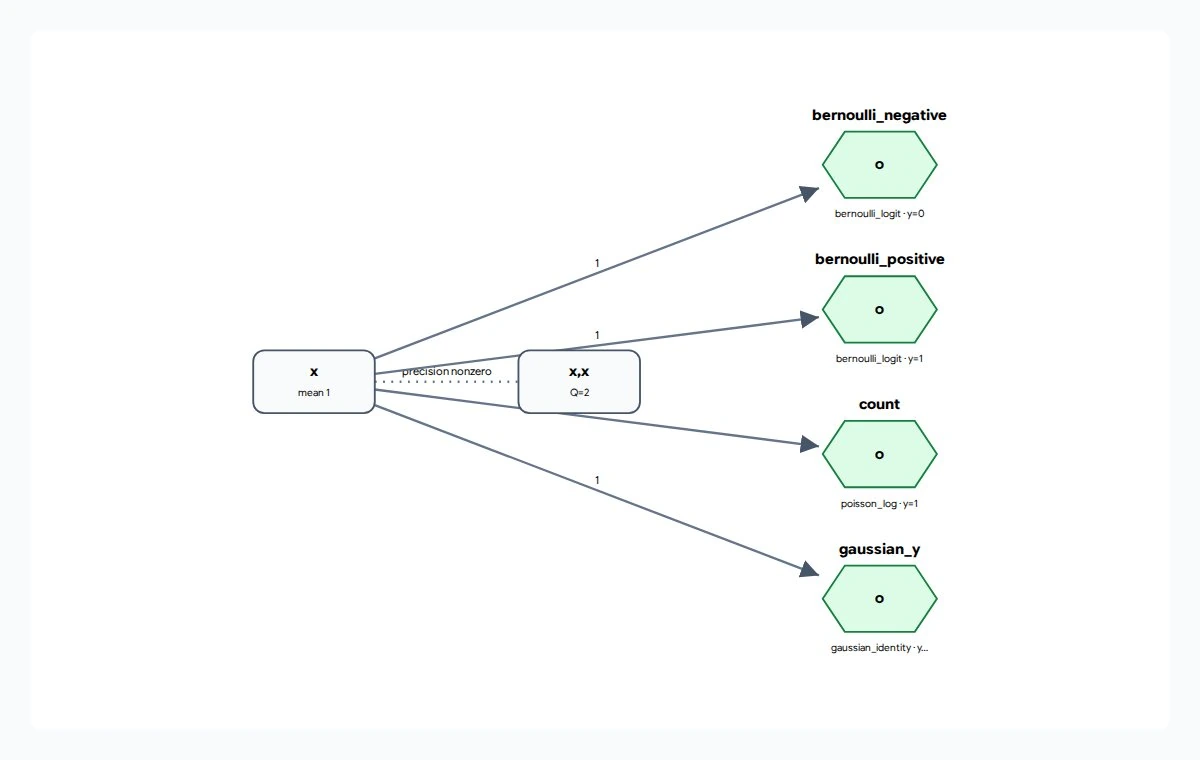
Sparse latent Gaussian Markov random field (GMRF)
A model of hidden numeric quantities with Gaussian uncertainty and a sparse dependence structure. Different types of observations can provide evidence about those hidden quantities.
What does a mix of binary, count and numeric observations imply about the hidden value x?
The rectangle x is the hidden variable. Green observation nodes provide different measurement types. The x,x box is an uncertainty parameter, not another observed variable. This fixture contains only one hidden dimension.
Synthetic example, not real patient, customer or operational data.
Variables and symbols
- x
- An abstract hidden real-valued quantity with prior mean 1; no physical unit is specified.
- x,x and Q
- The precision entry Q = 2. For this one-dimensional prior, precision is the inverse of variance, which measures uncertainty.
- bernoulli_negative and bernoulli_positive
- Binary observations with recorded values 0 and 1, related to x through a logit link.
- count and gaussian_y
- A count observation of 1 and a numeric observation of 1.2. The latter uses a bell-shaped measurement model. O means observation.
When to use it
Estimate a spatial field from noisy measurements while preserving local dependence.
Applications
- Spatial monitoring: estimate a field between noisy measurement sites.
- Network telemetry: smooth local signals over a sparse dependency structure.
Why it matters
Posterior marginals show where estimates are uncertain enough to merit another measurement; they do not say what operational intervention causes the field to move.
Questions you can ask
- What are the posterior marginal means and variances?
Causal boundary
This family does not expose causal intervention or counterfactual queries. Dependencies, rules, dynamics, and decision actions alone do not establish those semantics.
Profile and resource limits
Positive-definite sparse precision is required. Gaussian observations admit exact inference; non-Gaussian likelihoods require explicit approximate Laplace inference. Sparse fill is bounded.
Online uses protected execution with plan and request limits. Check the returned method, exactness, and resource diagnostics for each query.
Existing workspace example
Sparse Latent-Gaussian GMRF
Sparse proper Gaussian precision fields with observation likelihoods and selected marginal inference. Explore its visual structure, edit the model through the workspace controls, and run the available analysis.
After signing in, open the workspace example gallery and choose this example. Workspace access and actions follow your plan.
Sign in to explore examplesUse it in your application
Released through the native engine and host software development kits (SDKs). Online and SDK resource profiles differ; check the documentation bundled with your exact SDK version.
Read SDK guidance and examples