Causal artificial intelligence (AI) · Model guide
Factor graphs
Combine overlapping constraints into one inspectable probability calculation without forcing an artificial direction on every relationship.
Describe a joint distribution using factors that connect subsets of variables.
Also known as: MRF.
The model in pictures
Factor graph
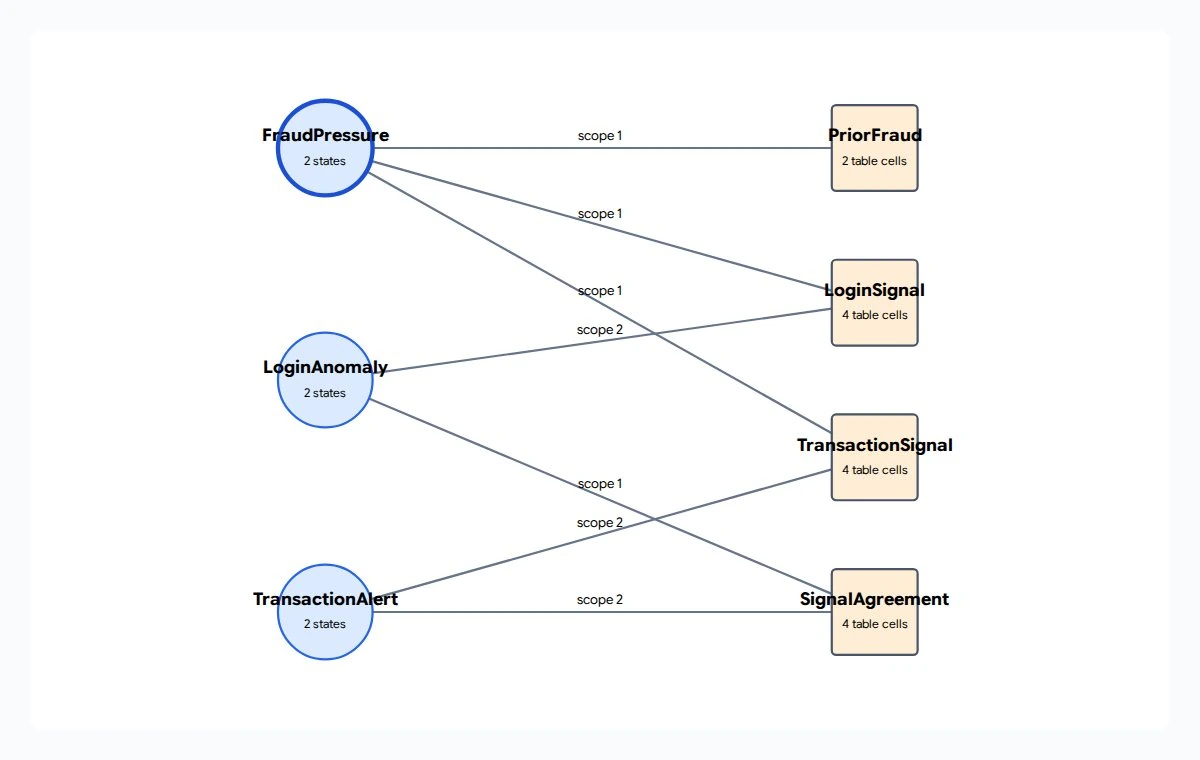
A probability model that separates variables from factors: tables scoring combinations of their possible values. Several factors can connect overlapping groups of variables.
What does a transaction alert imply about fraud pressure when login signals are also related?
Circles are variables and squares are factor tables. Lines identify which variables a factor uses, not causal directions. Scope labels indicate positions within a factor's inputs.
Synthetic example, not real patient, customer or operational data.
Variables and symbols
- FraudPressure
- The modeled fraud category: low or high.
- LoginAnomaly and TransactionAlert
- Two signals, each absent or present.
- PriorFraud
- The factor scoring fraud pressure before the other signals.
- LoginSignal, TransactionSignal, SignalAgreement
- Factors linking fraud to each signal and linking the two signals to one another. Table cells store combination weights.
Markov random field (MRF)
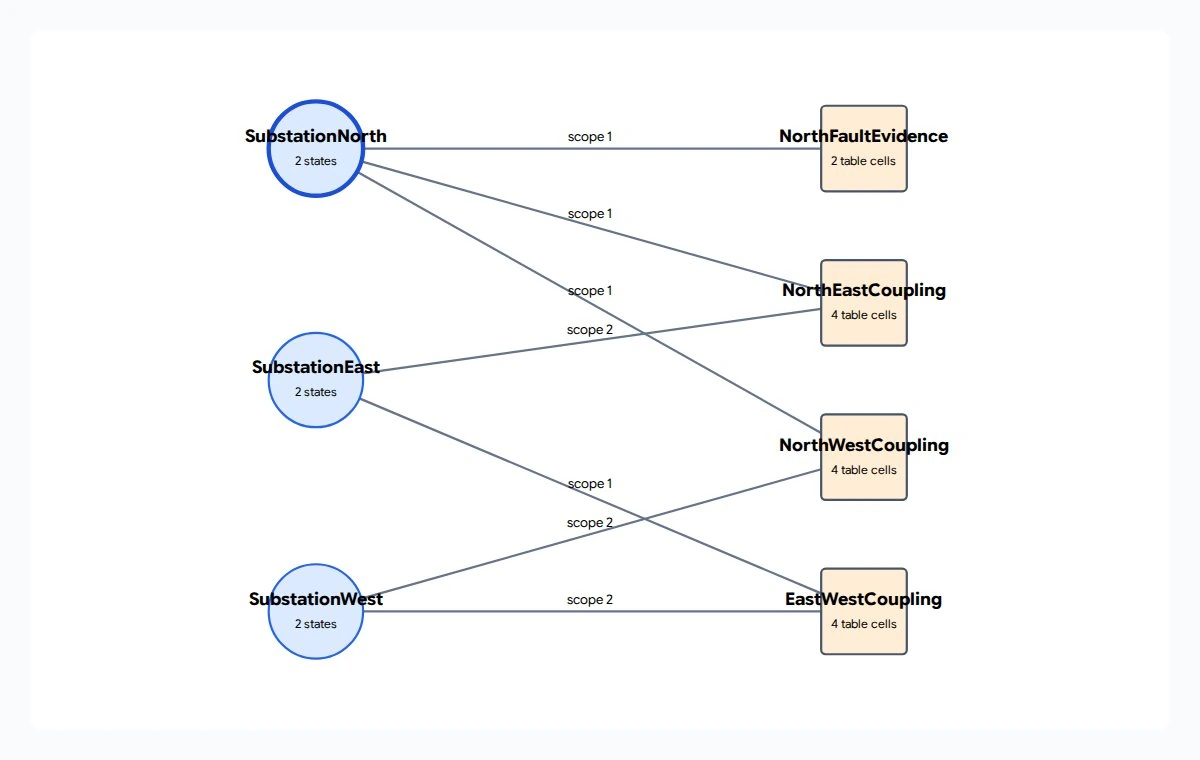
An undirected probability model for mutually related variables. It can describe neighboring sites whose conditions tend to agree, without declaring which one causes another.
What does an outage at one substation imply about the others?
This field is displayed as variables and factor tables. Circles are substations; squares score individual or paired conditions. Coupling means a statistical relationship, not an electrical wiring diagram.
Synthetic example, not real patient, customer or operational data.
Variables and symbols
- SubstationNorth, SubstationEast, SubstationWest
- The three sites, each in the normal or outage state.
- NorthFaultEvidence
- The factor scoring the northern substation's condition.
- NorthEastCoupling, NorthWestCoupling, EastWestCoupling
- Tables scoring how each pair's conditions fit together. Scope identifies a factor's variable inputs.
When to use it
Combine several overlapping fraud signals without forcing each relationship into a directed graph.
Applications
- Communications: decode a message by combining local parity constraints.
- Fraud review: fuse overlapping transaction, account, and device signals into a joint score.
Why it matters
Use the resulting beliefs to focus inspection or rank candidates, but evaluate the effect of any action separately because factors do not establish causality.
Questions you can ask
- Which hidden state is most plausible given the observed signals?
Causal boundary
This family does not expose causal intervention or counterfactual queries. Dependencies, rules, dynamics, and decision actions alone do not establish those semantics.
Profile and resource limits
Finite factor tables and graph width bound exact inference. Markov random fields are a supported representation within this family.
Online uses protected execution with plan and request limits. Check the returned method, exactness, and resource diagnostics for each query.
Existing workspace example
Coordinated Fraud Signals
Combine login anomalies and transaction alerts through overlapping factors to estimate fraud pressure. Compare exact elimination with loopy belief propagation on the same evidence.
After signing in, open the workspace example gallery and choose this example. Workspace access and actions follow your plan.
Sign in to explore examplesUse it in your application
Released through the native engine and host software development kits (SDKs). Online and SDK resource profiles differ; check the documentation bundled with your exact SDK version.
Read SDK guidance and examples