Causal artificial intelligence (AI) · Model guide
Discrete dynamic Bayesian networks
Dynamic Bayesian network (DBN)
Turn a stream of noisy alerts into an updated state estimate and test how a modeled action changes later risk.
Reuse a discrete dependency model across time to update beliefs as observations arrive.
Also known as: DBN, HMM.
The model in pictures
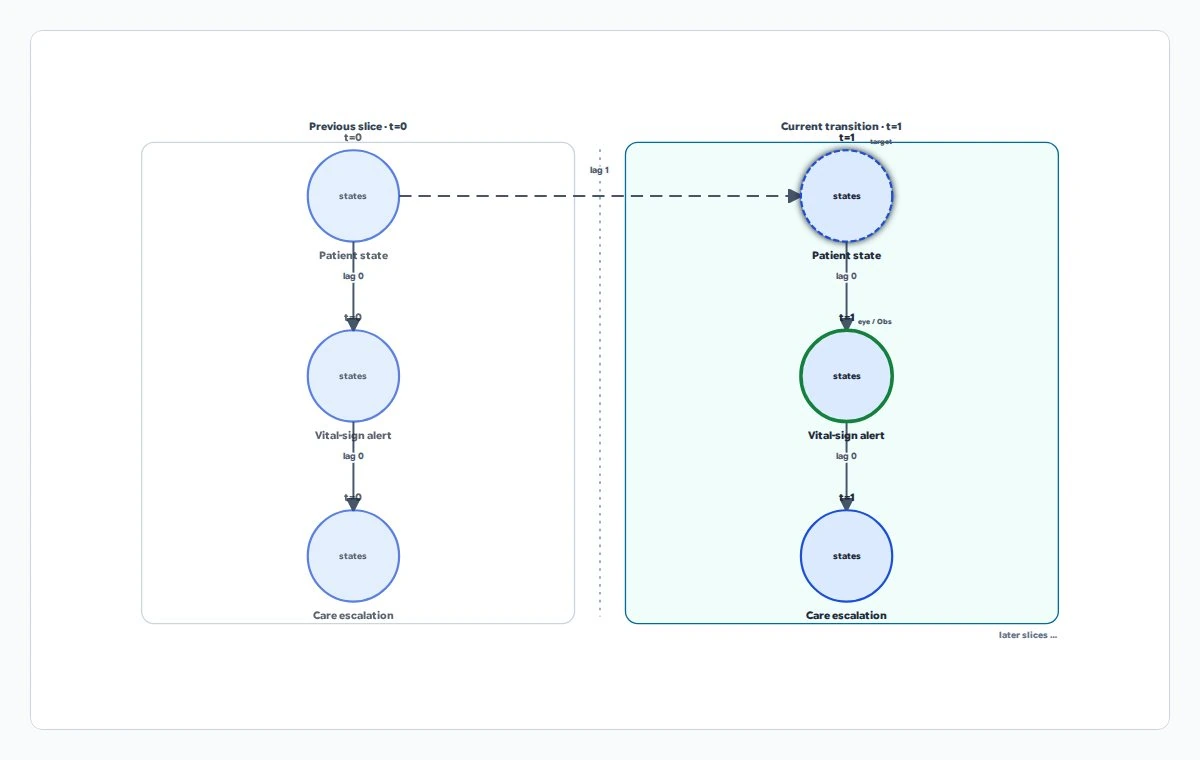
Dynamic Bayesian network (DBN)
A Bayesian network repeated over time. It relates today's uncertain state to the next one, so a new observation can update your estimate of what is happening.
What does an abnormal vital-sign alert tell us about the patient's current condition?
The two panels are successive ward rounds, not two patients. Solid arrows connect variables within a round; the dashed arrow carries patient state into the next round. The highlighted alert is entered evidence, not a diagnosis.
Synthetic example, not real patient, customer or operational data.
Variables and symbols
- Patient state
- The modeled condition: stable, deteriorating or critical.
- Vital-sign alert
- The observed warning signal: normal or abnormal.
- Care escalation
- The care category: routine or escalated.
- t, lag, Obs
- t is the round index. Lag 0 means the same round; lag 1 means the next. Obs means observation.
When to use it
Track deterioration risk from noisy ward observations over successive rounds.
Applications
- Equipment monitoring: update failure-state probabilities as inspections arrive.
- Service operations: track incident progression and compare a modeled response at a chosen time.
Why it matters
The model links today’s evidence to tomorrow’s state, while its causal query modes let you compare a declared action with merely observing the same event.
Questions you can ask
- What is the likely current state after the latest alert?
- How does the future state distribution change if an action is set at this time step?
- Given the observed sequence, what would the model predict if that action had differed?
Causal boundary
Supports interventions under the model’s declared structural assumptions.
Counterfactual queries additionally rely on the declared shared-noise model. These answers do not establish that the supplied causal assumptions hold in the real world.
Profile and resource limits
Stationary first-order finite-state templates; horizon, interface width, and factor growth are bounded. HMM is a profile within this family.
Online uses protected execution with plan and request limits. Check the returned method, exactness, and resource diagnostics for each query.
Existing workspace example
Early Warning for Patient Deterioration
Follow patient state, vital-sign alerts, and care escalation across ward rounds. Enter an abnormal alert at a time slice and compare exact filtering with particle inference.
After signing in, open the workspace example gallery and choose this example. Workspace access and actions follow your plan.
Sign in to explore examplesUse it in your application
Released through the native engine and host software development kits (SDKs). Online and SDK resource profiles differ; check the documentation bundled with your exact SDK version.
Read SDK guidance and examples