Causal artificial intelligence (AI) · Model guide
Decision analysis networks
Decision analysis network (DAN)
Compare available choices using the information, outcomes, and utility assumptions that were actually declared.
Represent chance, decision, and utility structure with explicit information available to each decision.
Also known as: DAN.
The model in pictures
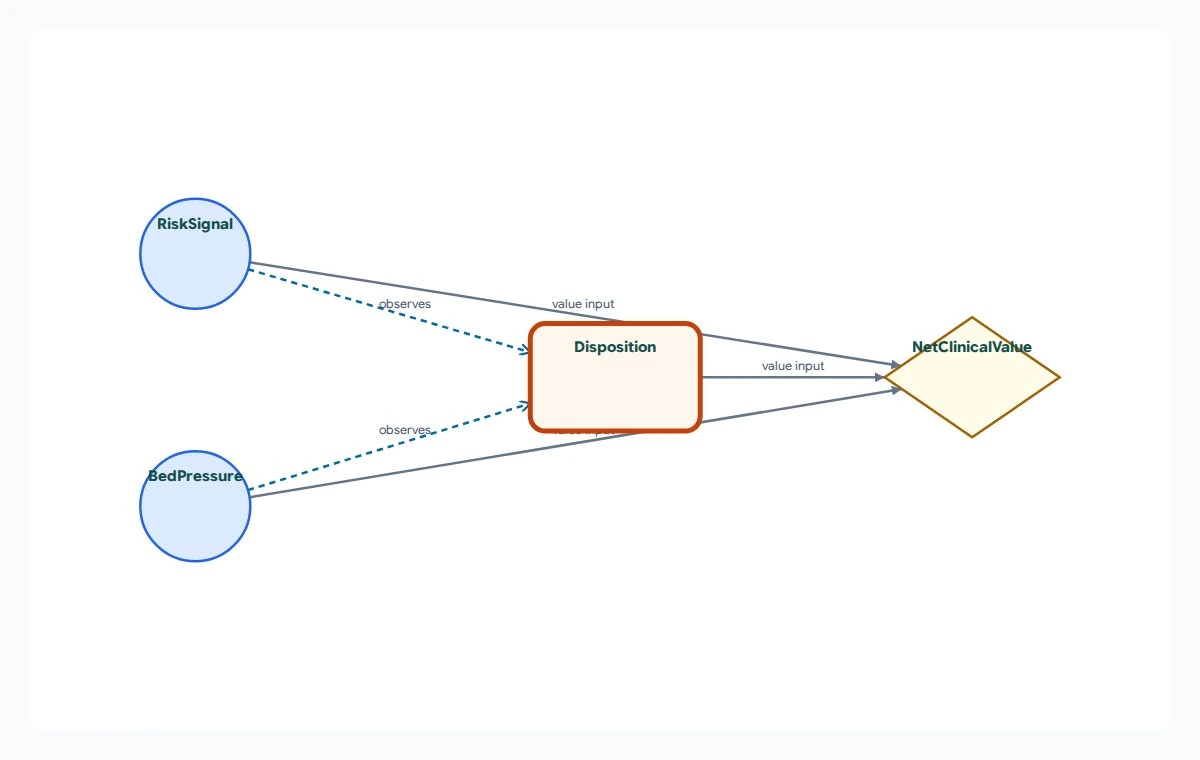
Decision analysis network (DAN)
A model relating available information, possible choices and the value of their consequences. It evaluates decisions at the information states that can actually be reached.
How should risk and available beds affect a modeled discharge, observation or admission decision?
Circles are uncertain inputs, the rectangle is a decision, and the diamond is a value score. Dashed arrows mark information available to the decision. No recommended disposition is displayed in this screenshot.
Synthetic example, not real patient, customer or operational data.
Variables and symbols
- RiskSignal
- The observed risk category: low or high.
- BedPressure
- Capacity is available or constrained.
- Disposition
- The choice: discharge, observe or admit.
- NetClinicalValue
- A model-defined score balancing clinical benefit and capacity cost, not a probability or validated clinical rule.
When to use it
Compare emergency department disposition choices under uncertain patient outcomes.
Applications
- Capital planning: compare staged investments under uncertain demand and cost.
- Incident response: rank admissible response policies under declared outcomes and tradeoffs.
Why it matters
The selected policy exposes which choice maximizes declared expected utility; changing the utility or information assumptions shows when the recommendation changes.
Questions you can ask
- Which admissible decision maximizes expected utility?
Causal boundary
This family does not expose causal intervention or counterfactual queries. Dependencies, rules, dynamics, and decision actions alone do not establish those semantics.
Profile and resource limits
Finite policy and information-state bounds; actions cannot use information unavailable at decision time. Utility optimization is not a Pearl causal query.
Online uses protected execution with plan and request limits. Check the returned method, exactness, and resource diagnostics for each query.
Existing workspace example
Emergency Department Disposition
Choose discharge, observation, or admission after seeing a risk signal and current bed pressure. Solve the reachable policy while balancing clinical benefit against constrained capacity.
After signing in, open the workspace example gallery and choose this example. Workspace access and actions follow your plan.
Sign in to explore examplesUse it in your application
Released through the native engine and host software development kits (SDKs). Online and SDK resource profiles differ; check the documentation bundled with your exact SDK version.
Read SDK guidance and examples