Causal artificial intelligence (AI) · Model guide
Continuous-time Bayesian networks
Continuous-time Bayesian network (CTBN)
Estimate state risk between irregular observations instead of forcing events into arbitrary time buckets.
Describe discrete states that change at continuous-time rates rather than fixed time steps.
Also known as: CTBN.
The model in pictures
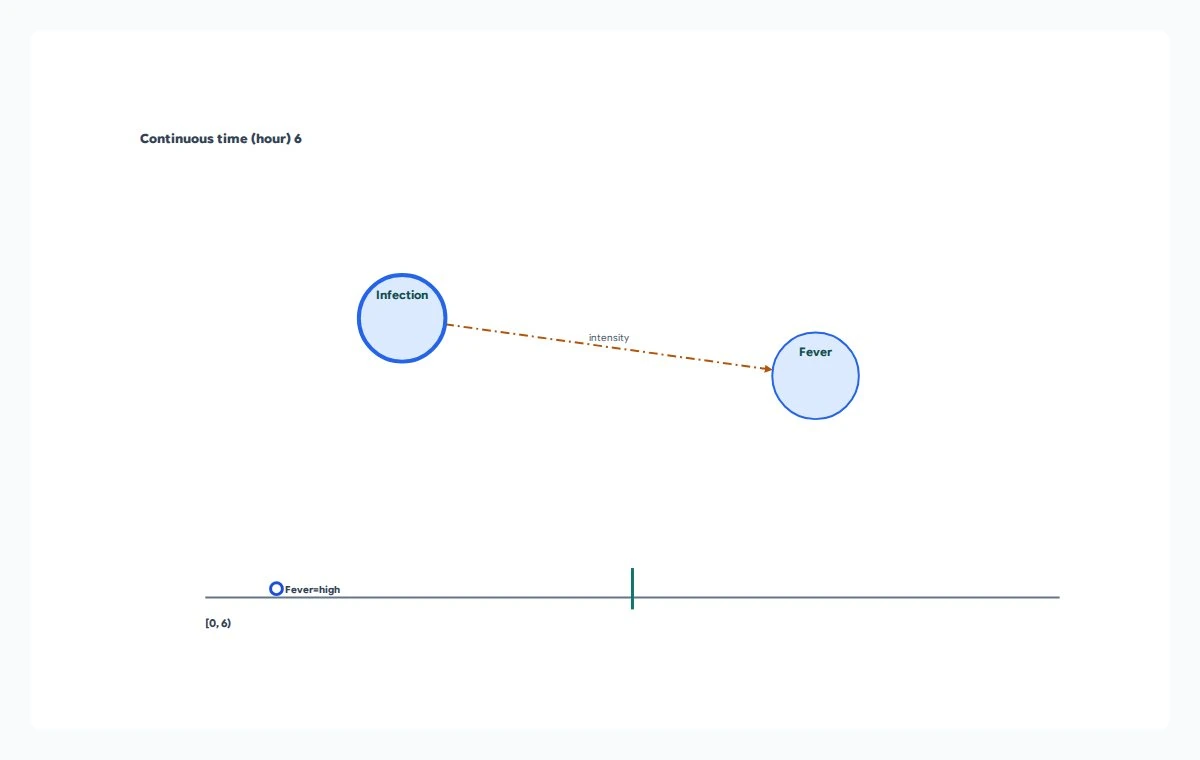
Continuous-time Bayesian network (CTBN)
A model of categorical states that can change at any moment, not just at fixed observation times. Rates describe how quickly those changes happen.
What is the modeled infection probability hours after a high-fever observation?
The arrow says the fever transition rates depend on the infection state. The lower timeline marks the entered high-fever observation and the current time cursor; it is not an infection-probability curve.
Synthetic example, not real patient, customer or operational data.
Variables and symbols
- Infection
- Whether infection is absent or present.
- Fever
- Whether fever is normal or high.
- Continuous time and intensity
- Time is in hours. Intensity means a state-change rate, not symptom severity; the pictured cursor is at hour 6.
When to use it
Explore how infection states evolve between irregular hospital observations.
Applications
- Reliability engineering: estimate component states between inspections.
- Service operations: model transitions among incident states when events arrive at uneven times.
Why it matters
Use elapsed-time probabilities to schedule attention or inspection, while treating the effect of an action as unmodeled because causal interventions are deferred.
Questions you can ask
- What state probabilities follow after an elapsed time interval?
Causal boundary
This family does not expose causal intervention or counterfactual queries. Dependencies, rules, dynamics, and decision actions alone do not establish those semantics.
Profile and resource limits
Finite-state rate matrices with bounded time and computation; causal intervention semantics are deferred.
Online uses protected execution with plan and request limits. Check the returned method, exactness, and resource diagnostics for each query.
Existing workspace example
Hospital Infection Dynamics
Model infection and fever as events that can change at any moment rather than fixed visits. Observe a fever time, move the hour cursor, and forecast infection risk from conditional intensities.
After signing in, open the workspace example gallery and choose this example. Workspace access and actions follow your plan.
Sign in to explore examplesUse it in your application
Released through the native engine and host software development kits (SDKs). Online and SDK resource profiles differ; check the documentation bundled with your exact SDK version.
Read SDK guidance and examples