Causal artificial intelligence (AI) · Model guide
Linear-chain conditional random fields
Linear-chain conditional random field (CRF)
Label an entire sequence coherently instead of classifying each position without its neighbors.
Model a conditional distribution of labels given explicit features of an observed sequence.
Also known as: CRF, LinearChainCRF.
The model in pictures
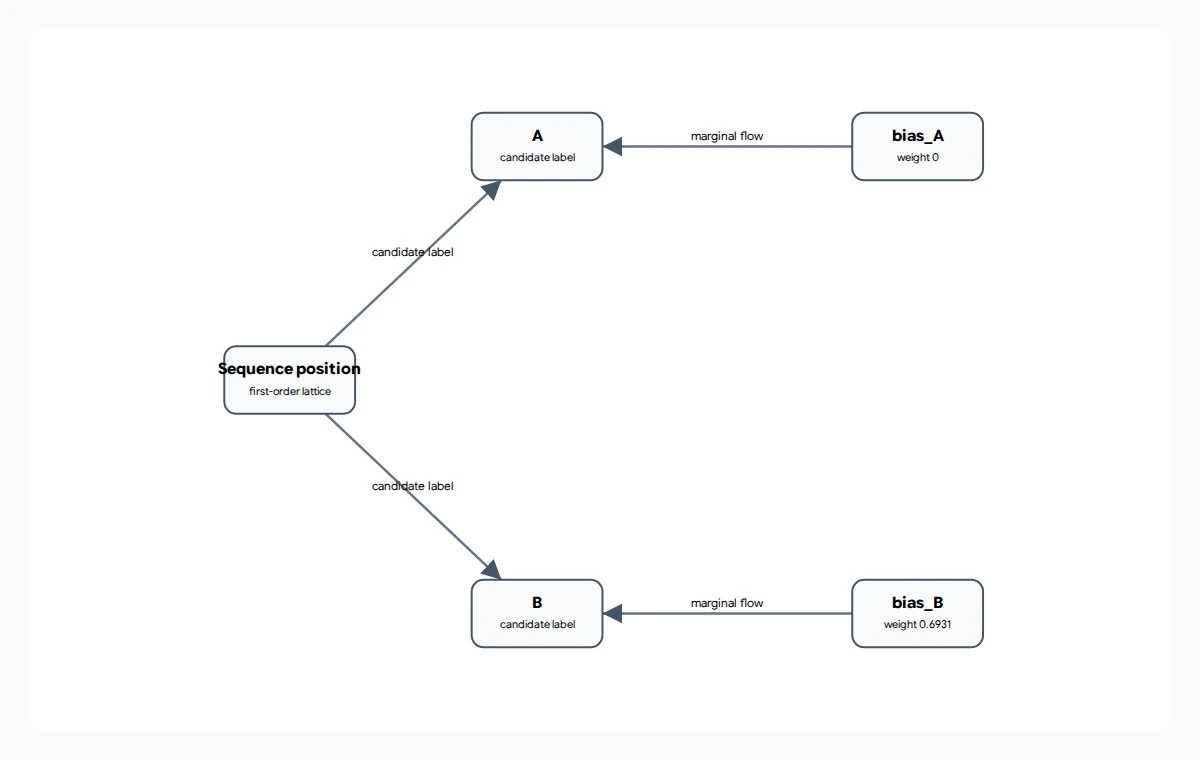
Linear-chain conditional random field (CRF)
A model that assigns labels to a sequence while considering observed features and neighboring labels. It models label probabilities given the input sequence.
Which label is most likely at each sequence position under the supplied feature weights?
This small example shows a sequence position, two candidate labels and their bias features. It illustrates the model's labeling structure, not a decoded sentence or a returned label sequence.
Synthetic example, not real patient, customer or operational data.
Variables and symbols
- Sequence position
- The item in an ordered sequence whose label is unknown.
- A and B
- The two possible labels. No real-world categories are assigned in this fixture.
- bias_A and bias_B
- Features scoring each label, with weights 0 and about 0.6931. Weights are scores, not probabilities.
When to use it
Assign labels to successive observations using both local features and adjacent-label preferences.
Applications
- Document processing: label tokens as names, dates, or other declared fields.
- Event streams: assign states to successive observations using local and transition features.
Why it matters
The best sequence supports extraction or routing, while any downstream action still needs separate policy and causal justification.
Questions you can ask
- What is the most likely complete label sequence?
Causal boundary
This family does not expose causal intervention or counterfactual queries. Dependencies, rules, dynamics, and decision actions alone do not establish those semantics.
Profile and resource limits
First-order finite labels and features; exact dynamic programming is bounded by sequence length, label count, and top-k size. Training and neural encoders are outside this profile.
Online uses protected execution with plan and request limits. Check the returned method, exactness, and resource diagnostics for each query.
Existing workspace example
Linear-Chain CRF
First-order conditional random fields with explicit label, state, transition, and boundary features. Explore its visual structure, edit the model through the workspace controls, and run the available analysis.
After signing in, open the workspace example gallery and choose this example. Workspace access and actions follow your plan.
Sign in to explore examplesUse it in your application
Released through the native engine and host software development kits (SDKs). Online and SDK resource profiles differ; check the documentation bundled with your exact SDK version.
Read SDK guidance and examples