Causal artificial intelligence (AI) · Model guide
AMP chain graphs
Andersson-Madigan-Perlman (AMP) chain graph
Evaluate dependencies in a mixed-edge system without substituting a different chain-graph interpretation.
Represent finite discrete dependencies under Andersson–Madigan–Perlman mixed-edge semantics.
Also known as: AMP Chain Graph, AMP CG.
The model in pictures
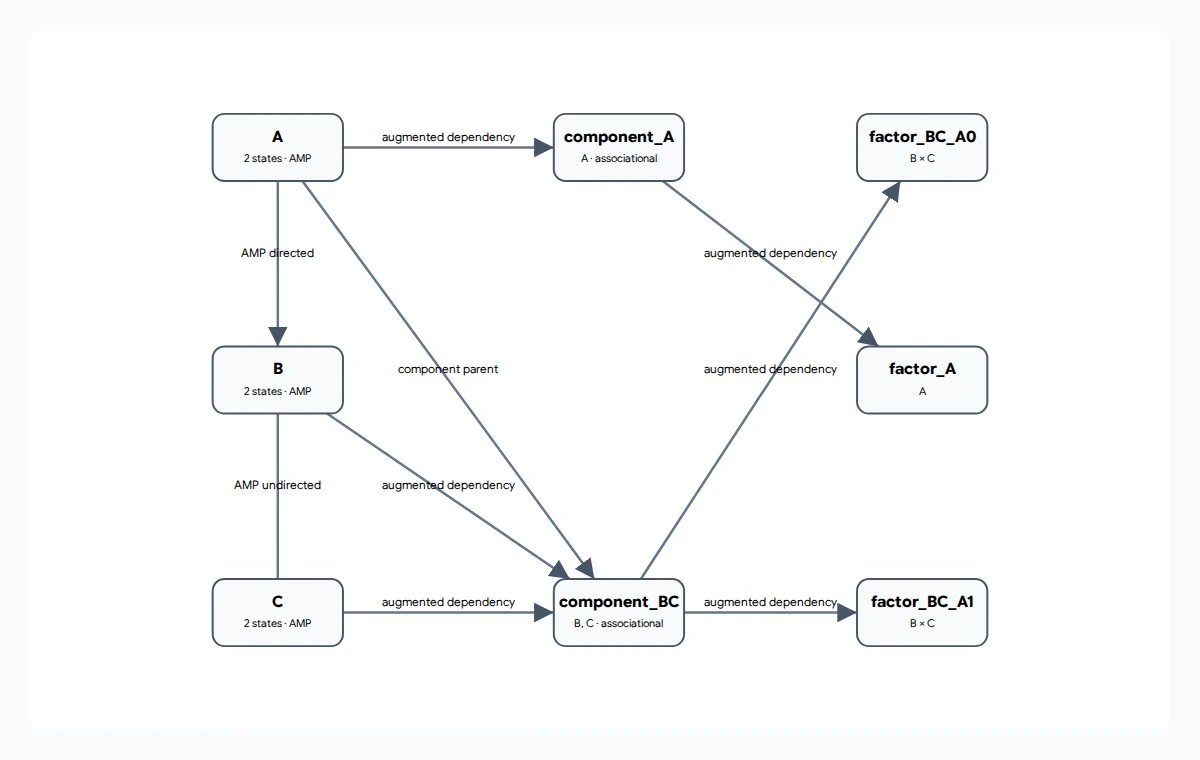
Andersson-Madigan-Perlman (AMP) chain graph
A probability network with both directed and undirected links. AMP specifies which variables can be treated as independent once other information is known; these rules differ from those of LWF chain graphs.
How do A's two possible states enter the probability calculation for B and C?
The left-hand A, B and C boxes are the variables. The other boxes show their groups and probability tables, not extra measurements. The augmented-dependency links expose that calculation structure. Directed edges here describe association, not causal effects.
Synthetic example, not real patient, customer or operational data.
Variables and symbols
- A, B and C
- Three abstract variables with states 0 and 1. This mathematical fixture assigns them no real-world units or meanings.
- component_A, component_BC
- The groups containing A alone and B with C. A is the parent of the second group.
- factor_A, factor_BC_A0, factor_BC_A1
- Probability tables for A and for the B/C pair when A is 0 or 1. B x C means combinations of B and C states.
- LWF
- Lauritzen-Wermuth-Frydenberg, the other chain-graph interpretation. Similar-looking graphs are not interchangeable models.
When to use it
Combine directed component dependencies with within-component associations under an explicit AMP model.
Applications
- Systems reliability: combine ordered component dependencies with within-stage associations.
- Organizational modeling: condition on variables connected through an explicitly declared AMP structure.
Why it matters
Marginals help locate states that deserve investigation, while AMP mixed edges do not establish what would happen under an intervention.
Questions you can ask
- What is the marginal probability of a component variable?
Causal boundary
This family does not expose causal intervention or counterfactual queries. Dependencies, rules, dynamics, and decision actions alone do not establish those semantics.
Profile and resource limits
Strict positivity, validated AMP component constraints, and bounded exact factor work are required. LWF packets cannot be relabeled AMP; no external competitive-parity claim is made.
Online uses protected execution with plan and request limits. Check the returned method, exactness, and resource diagnostics for each query.
Existing workspace example
Finite Discrete AMP Chain Graph
Finite discrete AMP mixed-edge models with augmented-closure factorization; associational only, not LWF or causal. Explore its visual structure, edit the model through the workspace controls, and run the available analysis.
After signing in, open the workspace example gallery and choose this example. Workspace access and actions follow your plan.
Sign in to explore examplesUse it in your application
Released through the native engine and host software development kits (SDKs). Online and SDK resource profiles differ; check the documentation bundled with your exact SDK version.
Read SDK guidance and examples